Automatic Obstacle Avoidance: Your Co-Pilot in the Sky
April 02, 2026
There’s nothing quite like unboxing a new drone. Laying out every sleek new component, getting a feel for the controller, and imagining that first perfect flight. Then, a niggling doubt creeps in: "What if I crash it on takeoff?" In an instant, the fear that one small mistake could lead to an expensive, complicated repair is enough to keep your biggest cinematic ambitions grounded before they ever leave the ground. But what if your drone were smart enough to act as your co-pilot, actively protecting itself from the unexpected? What if it could see the world the way you do?
This is where modern flight technology changes everything. We'll be exploring the incredible systems that make up a drone's automatic avoidance systems. You'll discover the different types of sensors that act as a drone's eyes, from stereo cameras to infrared, and learn about the most critical drone safety features that make flying more intuitive and far less stressful.
How Does an Obstacle Avoidance System Work?
A drone is more than just a flying camera. At its heart, it’s a drone equipped with a sophisticated network of sensors, acting as its eyes, and an onboard computer, its brain. This system constantly scans the environment in real-time, identifying potential hazards like trees, walls, and especially people. This allows it to react to an obstacle in its path and automatically prevent a collision.
This technology gives the drone true spatial awareness, understanding distance and trajectory rather than just detecting objects. That’s what makes fluid movement possible even in tight environments and allows creators to reliably capture smooth cinematic shots without constantly panic-braking mid-flight.
How Does a Drone 'See' the World
To truly grasp how drones avoid obstacles, we need to look beyond the main camera used for filming. These intelligent flying platforms are equipped with a sophisticated suite of specialized sensors, each providing unique input with which to perceive the world. It’s this fusion of different sensory inputs that creates a comprehensive, real-time awareness of the environment.
The most obvious technology is Stereo Vision, which uses the drone's cameras to function much like our own eyes. By using two or more cameras spaced a small distance apart, the drone's processor compares the images to calculate depth and build a detailed 3D map of its surroundings. This is incredibly effective for identifying objects with clear textures in well-lit conditions. However, just like human vision, it can be challenged by uniformly textured surfaces like a snowfield or a blank wall, and its performance can degrade in low light.
For detecting immediate, close-range threats, many drones also incorporate Infrared and Ultrasonic Sensors. Infrared sensors emit beams of invisible light and measure the reflections, while ultrasonic sensors use high-frequency sound waves, essentially a form of sonar like a bat uses. These are excellent, reliable systems for detecting large, solid objects, often used to ensure smooth landings or maintain a consistent altitude above the ground. Their primary limitation is a shorter effective range and an inability to perceive fine details like thin branches.
But these sensors are just the eyes. The real magic happens in the drone's powerful onboard flight controller. This processor runs incredibly complex algorithms that take in terabytes of raw data from all these different sensors, instantly fusing them into a single, cohesive understanding of the world. It’s this brain that makes the final call for autonomous drone navigation, telling the drone what to do in case of danger.
A New Standard of Safety: 360 Drones
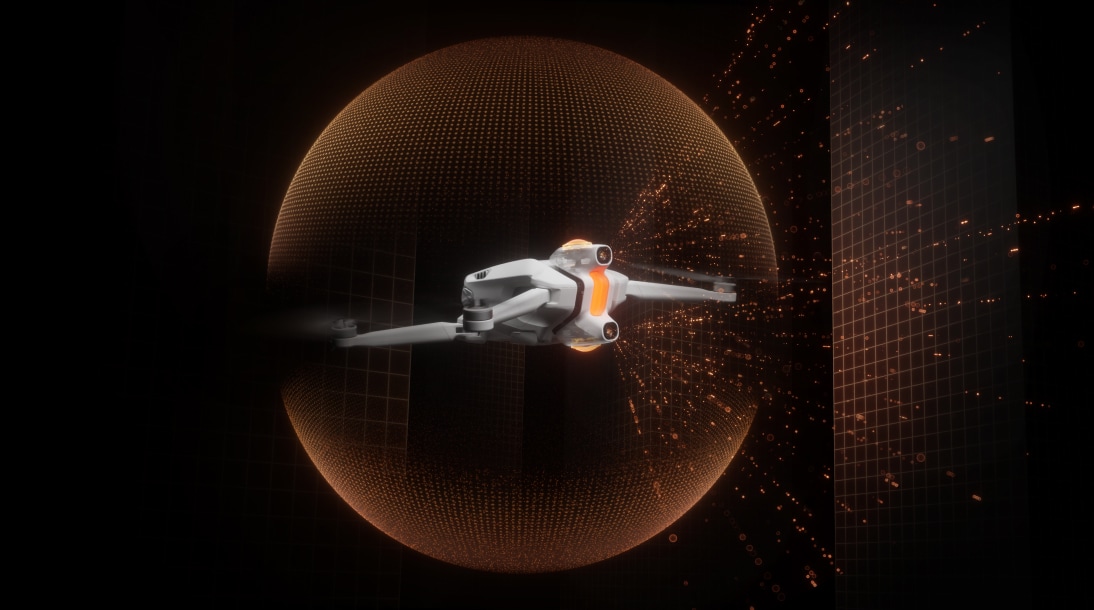
Not all avoidance systems are created equal. Early drones could only see forward and backward, limiting their protection against threats from above and below. Now with the advent of 360 drones, drones can see in all directions, creating an omnidirectional sphere of awareness.
Antigravity A1 is set to be upgraded with this new technology and demonstrate why this is an essential step forward in drone safety. The system combines 360 sensing with forward- and downward-facing binocular vision to detect obstacles from every angle. With enhanced horizontal and vertical awareness, the A1 can now identify obstacles in all directions: front, back, left, right, above, and below, keeping flights safer than ever.
This new layer of perception also unlocks a more advanced method of obstacle avoidance. Previously, A1 could only brake when encountering an obstacle. Now, with its 360 vision, it can calculate a new, safe path around potential hazards.
The Real-World Benefits of Obstacle Avoidance
So, what does all this advanced technology actually mean for you, the aerial content creator, on a regular Saturday afternoon? The most immediate benefit is a massive boost in confidence. That nagging fear of a costly mistake fades into the background, replaced by the freedom to experiment and explore. This can be doubly increased with immersive displays like Antigravity Vision Goggles, which can help pilots judge distance and motion more intuitively than a flat phone screen. When spatial depth feels natural, beginners tend to make fewer overcorrections, which indirectly improves safety and smoothness.
But what about situations where you're not directing the drone's actions? That's when obstacle avoidance really shines. For example, for A1 features such as Sky Path, which allows you to program in a flight path and freely share the experience with flight with even inexperienced pilots, obstacle avoidance and stabilization help ensure no unexpected surprises derail the flight. Similarly, when using Deep Track to follow a subject, obstacle avoidance keeps A1 on target, even in complex environments like forests, letting you get the perfect shot while elegantly dancing around the trees.
This same technology is also transforming professional industries, from infrastructure inspection to farming and drones applications, where autonomous flight paths protect equipment while surveying large areas efficiently.
FAQ
What about nighttime flights?
Navigating in darkness depends on the drone's sensors. Systems using stereo vision cameras need light to see, so their performance decreases in fog or at night. However, advanced systems with LiDAR or infrared sensors are different. They create their own invisible light, allowing the collision avoidance drone to build an accurate 3D map of its surroundings regardless of the time of day.
Do I still need to pilot carefully?
Absolutely. The most important safety feature is an alert and responsible pilot. Obstacle avoidance is an incredible safety net for flying in complex environments, but it doesn't replace your own good judgment. Always perform pre-flight checks, keep the drone within your line of sight, and be aware of your surroundings. Technology is there to assist, empowering you to fly more creatively and safely than ever before.
Will it detect thin branches?
While today’s drone obstacle avoidance sensors are powerful, they have limits. Very thin objects like bare tree branches or power lines can be difficult to detect, especially when flying at high speed. It's essential to maintain situational awareness and treat this as a known blind spot. These advanced systems are designed to be a robust safety net, not an infallible shield against every potential hazard.
Conclusion
Feeling a little more at ease? We’ve explored how this remarkable technology helps ease the workload of flying, using a range of sensors to make split-second decisions that can prevent a flight from turning into a disaster. But remember: even the best technology is designed to support and enhance your abilities and can't replace your judgment as a pilot. Staying aware and attentive is still the most effective way to avoid costly repairs and keep flying safely day after day.
The only question left is, where will your newfound confidence take you first?
¿Estás en la lista?
Suscríbete para recibir las mejores historias, consejos y noticias directamente en tu bandeja de entrada.

