What is a Drone with Headset and Why is it So Popular?
2026/05/22What's your vision of flying? Surely not trapped looking at a flat 2D screen, but actually seeing the world from a bird’s-eye view as you soar over landscapes and weave through treetops. This is the heart of the immersive flight experience made possible by drone goggles, and it’s why this technology has captured the imagination of creators and explorers everywhere.
In this guide, we'll explore the incredible world of First-Person View (FPV) flight. You’ll learn how the technology works to put you in the sky, and what key features to look for when choosing your gear. Get ready to discover a completely new way to interact with drone flight and how to make the jump from remote operator to the pilot sitting in the virtual cockpit.
Understanding the FPV Drone Experience
Ok, first things first. FPV, is exactly what it sounds like. When flying, you see the world directly from the drone's perspective. This is the core principle that defines the immersive flight experience. With most traditional drones, you fly by looking down at a smartphone or a small screen on your controller. This creates a natural disconnect; you are an operator on the ground, observing the action from a detached, third-person viewpoint.
FPV completely flips that script. Put on the goggles, and you're instantly transported into the sky for a profound connection that allows for next-level precision and intuitive control. Navigating through a dense forest or swooping low over a river becomes an instinctive act, not just a series of calculated joystick maneuvers. For aspiring creators, this is the ultimate tool for dynamic storytelling, opening the door for shots that feel fluid, energetic, and alive.
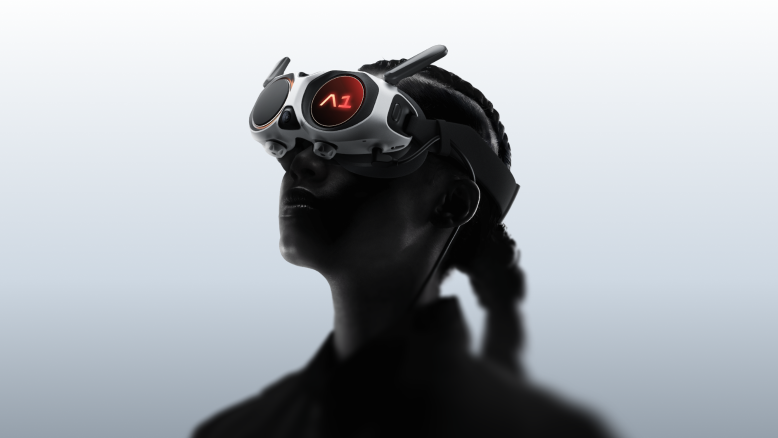
For pilots who want that immersive feeling without a steep learning curve, a new generation of goggles-based drones is emerging. The Antigravity A1 combines vision goggles with intuitive FreeMotion control. You simply point or look where you want to go, and the drone follows. Because it captures the entire scene in 360°, you don’t have to worry about framing while flying; you can choose cinematic angles after landing. This approach shifts the experience from “managing controls” to actually exploring the space, making FPV-style flight accessible even to complete beginners.
How FPV Goggles Work
So, how do FPV goggles work to create that seamless, in-the-moment feeling? First is the lightweight FPV camera on the drone itself. It's been optimized to capture and process video with the lowest possible delay, which is critical for a responsive experience.
Next, that video is instantly handed off to a video transmitter (VTX), which is like a miniature broadcast station attached to your drone. It takes the visual information from the camera and sends it out as a high-frequency radio signal. This is the crucial link that beams your drone's vision to your location.
Finally, your FPV goggles act as the personal receiving station. Inside the headset is a video receiver (VRX) tuned to the exact same frequency as the VTX. It catches the signal out of the air and immediately displays the live video on two high-resolution screens. This whole process happens in milliseconds.
This transmission technology generally comes in two main flavors: analog and digital. Analog systems, like an old television signal, offer near-instantaneous video but with lower image quality that can be distorted. Digital systems provide a crystal-clear, HD picture, much like a modern video stream, though they can sometimes have a slightly higher delay. The choice between digital vs analog FPV often comes down to a preference for image clarity versus the lowest possible latency.
Key Features to Look for in FPV Goggles
Choosing the best FPV goggles can feel overwhelming with so many technical specs to sort through. But don't worry, a few key features truly define the quality of your immersive flight experience. Focusing on these will help you choose the right gear for your creative adventures.
First, consider Display Resolution. Just like on your television, higher resolution means a sharper, more detailed image. We recommend looking for goggles with 1080p screens for a crisp, clear picture. This level of detail is essential for navigating your environment, helping you spot small obstacles or distant landmarks with the clarity needed for confident flying.
Next is the Field of View (FOV). This determines how wide your perspective is, measured in degrees. A larger FOV feels more like sitting in an IMAX theater, completely pulling you into the scene. While incredibly immersive, a very wide view can sometimes look a bit soft at the edges. Finding the best FPV goggles for beginners often means balancing an immersive FOV with image sharpness.
For comfort, Interpupillary Distance (IPD) Adjustment is non-negotiable. This feature lets you adjust the spacing of the lenses to perfectly match the distance between your pupils. Getting this right merges the two screen images into one clear, focused view, preventing eye strain during longer flights.
If you want all of the above in one streamlined package, take a look at the Antigravity A1 Vision Goggles. Lightweight and built to elevate the FPV experience, they feature 2.5K micro-OLED displays for exceptional image quality and crisp detail, responsive head tracking, built-in diopter adjustment, and more. When designing A1, we aimed to rethink every part of the drone experience, and the Vision Goggles are the next step in bringing you even closer to the clouds.
FAQ
Do all drones work with goggles?
No, most drones are not compatible. Goggles require a dedicated FPV system, including a special camera and video transmitter (VTX). Typical camera drones send video to a phone and lack the low-latency hardware needed for a true immersive flight experience.
Can I wear glasses with FPV goggles?
It depends. Larger "box" style goggles might fit over small glasses, but most slim, low-profile headsets won't. The ideal solution is built-in diopter adjustment. These can be used to match your prescription, giving you a sharp view without needing your glasses.
What is the difference between box and low-profile goggles?
Box goggles use a single large screen in a bulky housing and are a great budget option, making them the best FPV goggles for beginners. Low-profile, or "binocular" goggles, use two smaller screens. They are more compact and offer a premium image, but usually cost more.
Conclusion
Drone goggles are more than a fancy bit of eyewear. They're a new way to experience flight, creativity, and perspective. Now that you understand how the system works and what to look for in your gear, the next step is simple: start building confidence with an FPV simulator, then move to a beginner-friendly kit when you’re ready to fly for real. Whether you’re drawn by the thrill of immersion or the possibilities of visual storytelling, FPV opens the door to seeing the world in an entirely new way.