New Pilots: Guide to First Flight
April 02, 2026
Have you ever looked at a stunning landscape and wished you could see it from a little higher or a little closer? Have you wanted to give your adventures the epic, sweeping treatment you see in films? For years, this kind of storytelling was complex and expensive, but today, it’s more accessible than ever.
In this starter drone guide, we'll help you navigate your first steps into the exciting world of aerial creativity. We'll break down everything from choosing one of the best drones for beginners to understanding the essential drone safety tips for your first flight. Are you wondering how to fly a drone for the first time? Or what the most important rules are? We’ve got you covered on your journey to the skies.
Core Concepts
Before you take to the skies, it helps to understand what’s happening under the hood. Modern drones aren't just remote-controlled toys; they are sophisticated flying robots packed with technology designed to make flight stable, safe, and intuitive. Getting to grips with a few core ideas will build your confidence and transform your first flight from intimidating to exciting. It all starts with the fundamentals of how these amazing tools work.
The Basics of Flight
At its heart, a drone's flight is a delicate dance of physics, managed by a smart onboard computer. Four propellers work in pairs, spinning in opposite directions to cancel out torque and keep the drone from spiraling. To go up, all four propellers speed up to generate more lift. To move forward, the rear propellers spin faster, tilting the drone so its thrust pushes it ahead. This constant, subtle adjustment is handled by the drone's flight controller, its central brain, which uses data from various sensors to maintain perfect balance, even in a light breeze. You don't have to manage the physics; you just tell the drone where you want to go.
You're the Pilot - Understanding Drone Controls
For most drones, the controller is your connection to the sky. Typically, it features two joysticks. The left stick usually controls altitude (throttle) and rotation (yaw), while the right stick directs movement forward, backward, left, and right (pitch and roll). Mastering this setup and learning to coordinate both thumbs is the key to producing smooth, cinematic movements.
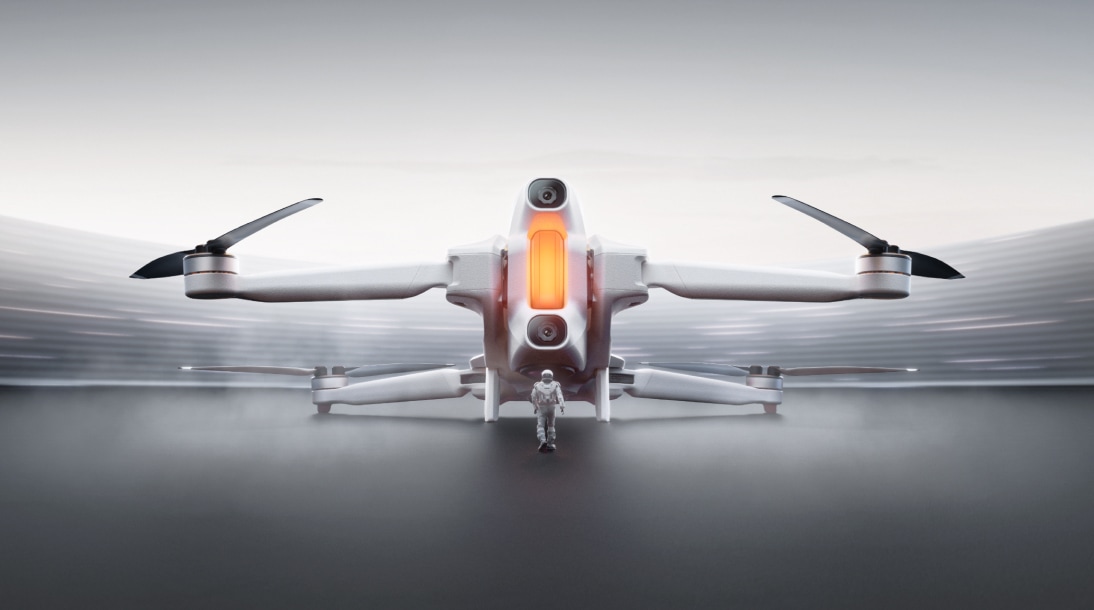
We saw this complexity as a barrier for many aspiring creators. That’s why we designed Antigravity A1 with FreeMotion control. Instead of wrestling with joysticks to frame the perfect shot, you simply look and point where you want the drone to go. The flight becomes an extension of your intention, making the entire process of learning how to fly a drone feel more natural from the very first moment.
The Invisible Systems Keeping You Safe
Your drone is constantly working to help you succeed. One of the most important systems is GPS. By connecting to a satellite network, the drone always knows its exact location. This enables features such as automatic Return-to-Home, which returns to its takeoff point if it loses connection or the battery runs low. Internally, gyroscopes and accelerometers measure the drone's orientation and movement thousands of times per second, ensuring it remains stable and responsive. Many modern drones also feature obstacle-avoidance sensors that act as the drone's eyes, preventing collisions and giving you the freedom to fly with greater peace of mind. These systems work together to create a safety net that lets you focus on your creativity rather than just avoiding crashes. Understanding them is a vital step in knowing how to fly a drone responsibly.
Practical Application
Knowing how your drone works is the first step; applying that knowledge is where your creative journey truly begins. The gap between theory and flight is crossed with a little preparation. Think of this not as a rigid set of rules, but as your launchpad for confident flying. Embracing a few core drone safety tips from the start builds good habits that free you up to focus on capturing incredible moments later on.
Know Before You Go - Location is Everything
Your first flight location should set you up for success. We recommend a wide-open field or park, far from people, buildings, and power lines. An empty soccer field on a calm day is a perfect training ground. Before you pack your gear, it’s essential to check local airspace rules.Apps can instantly show if you're near an airport or in a restricted zone. This is one of the most important drone safety tips, ensuring you're flying legally and responsibly. In many regions, you may also need to complete your FAA drone registration before flying, so be sure to verify this requirement. A safe location is a blank canvas for your first aerial masterpiece.
Your Pre-Flight Checklist
Every great creator has a process, and for drone pilots, it starts before takeoff. A consistent pre-flight check takes less than a minute but makes a world of difference. Here’s a simple ritual to adopt:
- Check Your Gear: Ensure the drone’s battery and controller are fully charged. Glance at the propellers to confirm they're undamaged and securely attached.
- Survey Your Surroundings: Take a 360-degree look around your takeoff spot. Note any potential obstacles, such as tree branches, lampposts, or uneven ground.
- Clear for Liftoff: Make sure your takeoff area is flat and clear of debris like leaves or small rocks that could get kicked up by the propellers.
First Flight - Keep it Simple
For your inaugural flight, the goal isn't to capture a cinematic masterpiece; it's to get a feel for the controls. Start by taking off and hovering a few feet off the ground. Get comfortable maintaining a stable position before proceeding. Gently test the controls: move forward a little, then back. Try moving side to side. Practice rotating the drone slowly. These small, deliberate movements are crucial for building muscle memory and confidence. Resist the temptation to fly high and fast. Spend time making the drone an extension of your will in a small, controlled space. Land gently, and congratulate yourself—you’re officially a pilot.
FAQ
Do I need a license to fly a drone?
In many countries, recreational pilots must pass a basic safety test, and commercial use often requires certification. Always check your local aviation authority before flying. Here is a more detailed guide on whether you need to license your drone.
How high can beginners safely fly?
Most regions restrict recreational flights to specific altitude limits (often around 120 m / 400 ft). Staying low also helps maintain visibility and control.
Are obstacle avoidance sensors enough to prevent crashes?
They help significantly, but they don’t replace awareness. Thin branches, wires, or low light can still challenge sensors, so always maintain a visual line of sight. Here is more information about how drones avoid obstacles.
How do I make cinematic footage?
Smooth motion, slow turns, consistent altitude, and gentle acceleration are the basics. Practicing simple drone photography techniques such as reveal and orbit shots dramatically improves results.
Conclusion
Your aerial storytelling journey is just beginning. If you want to move beyond simply piloting and focus on storytelling, the right tools can help. Antigravity A1 is designed for that, capturing the full 360° scene, so you can stop worrying about framing in flight and choose your composition later.
The takeaway: you don’t need to be an expert pilot to be a great creator. Today’s easy-to-fly drones handle the technical complexity so you can focus on your vision. Your first flight is a milestone, and now you can continue to grow, gain confidence, discover new angles, and unlock a whole new perspective. The sky is your canvas, it's time to explore!
Êtes-vous sur la liste ?
Abonnez-vous pour recevoir les meilleures histoires, astuces et actualités directement dans votre boîte de réception.

