Taking the First Steps into Drone Videography
March 26, 2026
Have you ever watched a film and been captivated by a breathtaking aerial shot, watching in awe as the camera soars effortlessly over a mountain ridge or circles a stunning landmark far below? That immersive, cinematic perspective is no longer reserved for Hollywood blockbusters; it’s a powerful storytelling tool you can start using today.
In this comprehensive guide to aerial videography, we’ll cover everything you need to turn your creative vision into professional-looking works of art. You’ll learn the fundamentals of drone filmmaking, discover the best camera settings for different shooting conditions, and build the essential editing skills needed to shape your footage into a compelling visual story.
Mastering the Fundamentals of Drone Videography
Before you can capture breathtaking cinematic drone shots, you need to master the fundamentals of smooth, controlled flight. When flying a drone, you’ll mainly rely on three basic controls: yaw to turn left or right, pitch to move forward or backward, and roll to move side to side. Remember to take it slow. Sudden, jerky movements are the quickest way to make your footage look amateurish. Instead, ease into every turn, ascent, and forward push. Equally important is maintaining a consistent altitude during a shot. This stability creates a polished, intentional feel that draws the viewer into the scene.
Another factor many beginners overlook is how important their equipment is in clearly seeing motion while flying. Traditional controller screens flatten depth perception, making smooth control harder to learn. Using immersive devices, like dedicated flight goggles, dramatically improves spatial awareness because you can perceive distance and movement naturally. Systems such as Antigravity Vision Goggles give you low-latency feed straight from the drone, allowing you to judge speed, distance, and framing instinctively instead of guessing from a tiny display.
The Golden Rule of Videography
To elevate your video from simple aerial footage to something truly epic, you need to take control of your camera's settings. Leaving it on auto is convenient, but mastering manual mode is where the magic happens. The most important principle to learn is the 180-degree shutter rule. Think of it as the golden ratio for motion in film. The rule is simple: your shutter speed should be double your frame rate. So, if you're shooting at 24 frames per second (the standard for a cinematic look), your shutter speed should be set to 1/50th of a second. This creates a natural, subtle motion blur that more accurately reflects the real world and is pleasing to the eye.
5 Core Drone Videography Shots
With your flight fundamentals and camera settings dialed in, it's time to build up your creative toolkit. These foundational maneuvers are the building blocks for compelling aerial sequences, turning simple flyovers into purposeful, narrative-driven visuals.
- The Reveal Shot: This is all about building anticipation. Start your drone behind an object, like a tree line, building, or hill, and slowly fly upwards or sideways to unveil the stunning landscape or subject behind it. It’s a perfect way to open a scene with a sense of discovery.
- The Orbit: A timeless classic. To perform this, you fly in a smooth, consistent circle around your subject, keeping it perfectly centered. The key is maintaining a constant speed and radius for a polished look.
- The Dolly Shot: Simple, yet incredibly effective. A "dolly in" means flying straight towards your subject, creating focus and intimacy. A "dolly out" involves flying directly backward, revealing the broader environment and giving context to the scene.
- The Fly-Through: This shot adds incredible depth and a sense of immersion. Find a natural frame, a gap between trees, an archway, or a window, and guide your drone smoothly through it for a dynamic effect.
- The Top-Down: For a completely unique perspective, point your camera directly down at the ground. Fly slowly over interesting patterns on coastlines, city streets, or forests to create mesmerizing, abstract visuals.
Choosing the Right Gear for Your Videography Goals
Selecting the right gear is a crucial step in bringing your aerial vision to life, but it doesn't have to be overwhelming. The true goal is to find a tool that feels like an extension of your creativity. While many drones focus on specs, the best systems remove technical barriers and let you focus on storytelling.
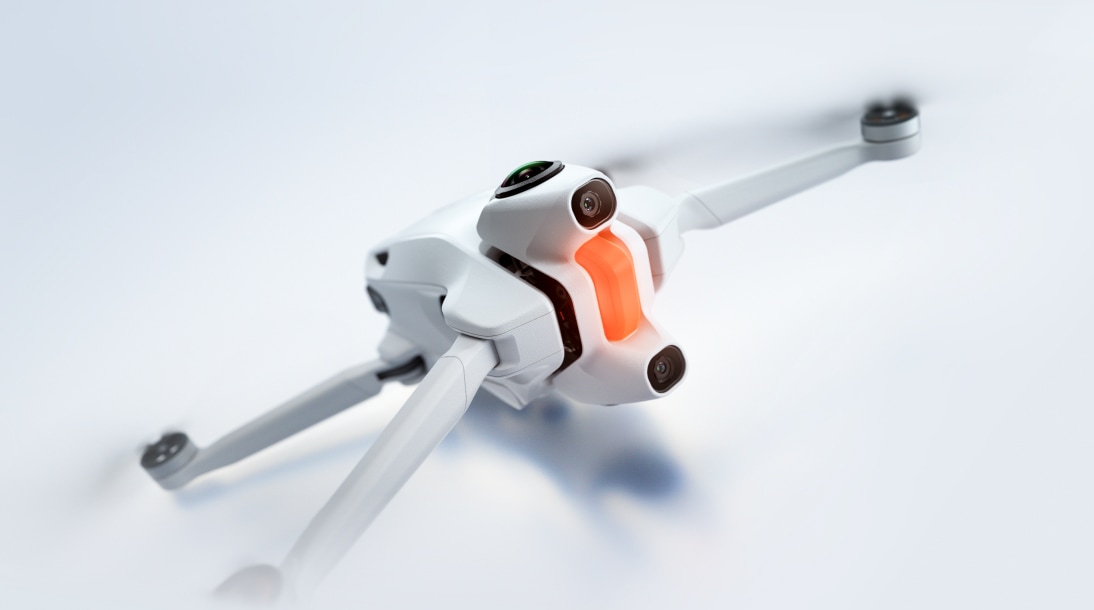
A good example of this new approach is the Antigravity A1, which offers a host of features designed to make aerial content creation as approachable as possible. Instead of forcing you to handle framing while piloting, it captures the full scene in 360°, so you can choose the angles you like best after landing (including angles you didn't even know were there!). Paired with intuitive motion-based control, you simply look or point where you want to go, and the drone follows. That isn't the only feature that A1 has to make drone flight more accessible. SkyGenie makes doing advanced shots, such as orbits and spiral ascents, as easy as pressing a button. Simply choose your subject and type of effect, and A1 will do the rest. Additionally, Sky Path lets you program a flight route after flying it just once. This not only lets you easily perform complex flight operations for the perfect cinematic shot, but also share the adventure with family and friends.
Conclusion
Now you have the blueprint to begin your journey into aerial storytelling, but the path to unlock your creative potential and transform how you see the world is just beginning. Action is where your story takes flight. Here are some steps you can take next to turn theory into practice.
- Purposeful Training: Don't try to master everything at once. This week, choose just one of the core shot, like the Orbit or the Reveal, and dedicate a flight to perfecting it.
- Watch Your Composition: Keep your subject clear in the frame and use leading lines, symmetry, or foreground elements to make shots more interesting.
- Start Editing: Download a free, powerful editing program like DaVinci Resolve and let your imagination run wild. Arrange your clips, play with color, and see how a story begins to emerge.
While this guide focuses on videography, many of these principles are directly transferable to drone photography. The world is a canvas, and you just picked up a new set of brushes. We can’t wait to see what you make!
FAQ
Do I need a license to fly a drone?
This depends on where you live and the purpose of your flight (recreational vs. commercial). Regulations vary significantly by country. For example, in the United States, the FAA has specific rules. We always recommend checking with your local aviation authority before your first flight.
How can I make my drone footage smoother?
The secret is simple: slow down. Sudden, jerky movements are the enemy of cinematic footage. Practice smooth takeoffs, slow turns, and gradual pushes forward to achieve that professional, gliding look.
What are the best drones for beginner drone filming?
For beginners, the best drone is one that feels intuitive and removes technical barriers. Look for a system that is easy to control, allowing you to focus on your creative vision instead of struggling with complex joysticks.
Sei già iscritto?
Iscriviti per ricevere le migliori storie, i consigli e le ultime novità direttamente sulla tua email.

